
Data Science Africa (DSA) is pleased to announce the launch of the 2026 Cohort of the Data Science to Advance Women’s Health (DSAWH) Fellowship, welcoming 24 outstanding early-career women researchers from across East and South Africa.
This second cohort builds on the success of the inaugural program, reinforcing DSA’s commitment to strengthening women-led research, expanding data science capacity, and advancing evidence-based solutions to critical women’s health challenges on the African continent.
The DSAWH Fellowship is designed to equip promising women researchers with advanced data science skills, mentorship, and hands-on research experience, enabling them to generate impactful insights that improve women’s health outcomes.
By combining technical training, applied research, leadership development, and community building, the fellowship empowers participants to translate data into actionable knowledge to support health policy, innovation, and real-world interventions.
The 2026 Cohort brings together 24 early-career women researchers from diverse academic and professional backgrounds, including:
- Public Health
- Epidemiology
- Biostatistics
- Clinical Research
- Biomedical Sciences
- Health Informatics
These fellows represent leading universities, research institutions, and health organizations across Kenya, Ethiopia, Uganda, Rwanda, Somalia, South Africa, Zambia, Zimbabwe, Tanzania, Malawi, and Botswana, fostering cross-country collaboration and strengthening Africa’s research ecosystem.
Throughout the fellowship, participants will apply cutting-edge data science tools to address pressing women’s health challenges such as maternal health, reproductive health, disease prevention, health systems strengthening, and gender-responsive health innovation.
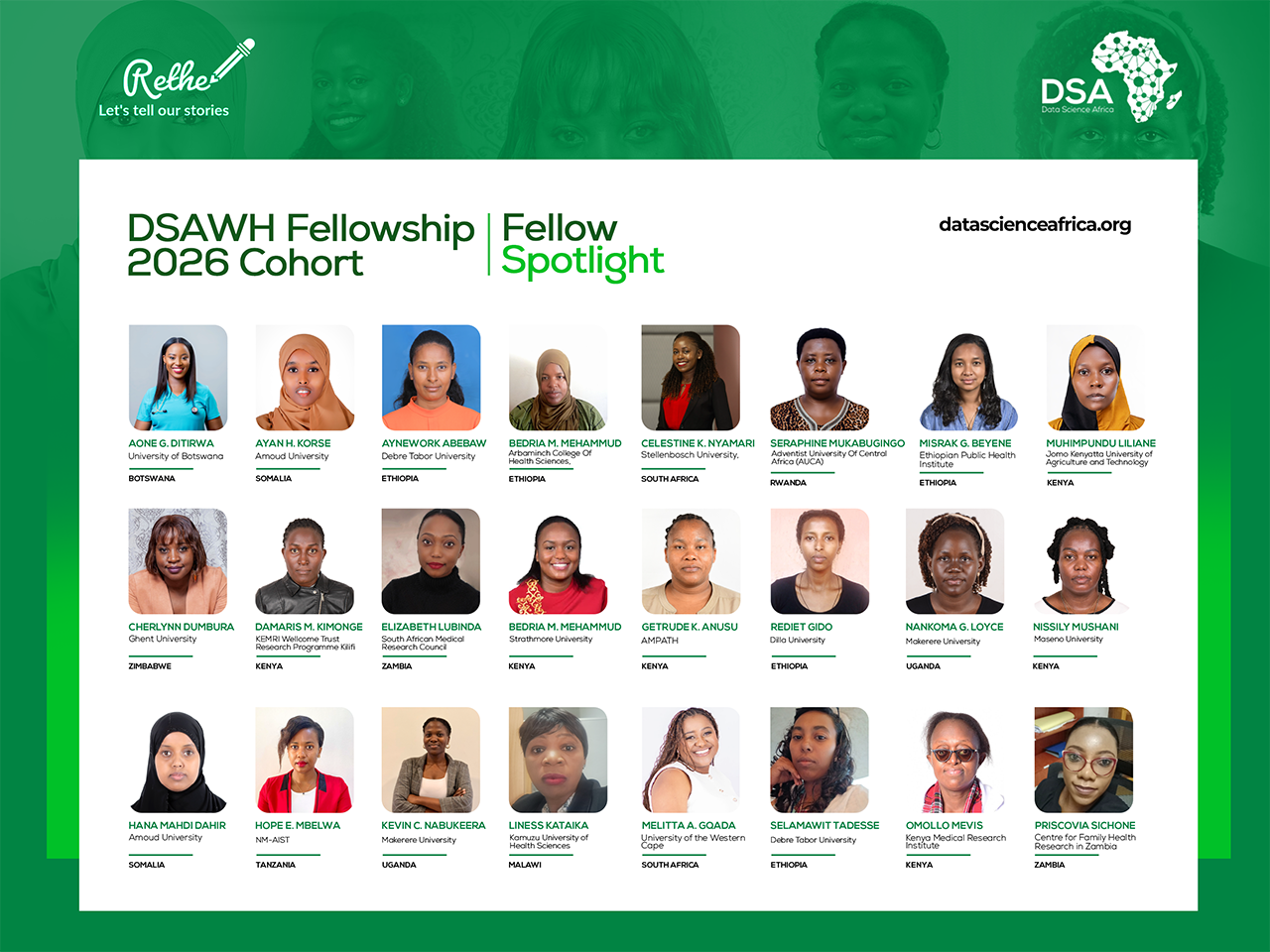
Meet the DSAWH 2026 Fellows
The DSAWH Fellowship 2026 Cohort features an exceptional group of women researchers committed to driving impact through data. Their collective work reflects the power of diverse perspectives, regional collaboration, and women-led scientific leadership.
|
Name |
Country |
Institution |
|
Aone G. Ditirwa |
Botswana |
University of Botswana |
|
Ayan H. Korse |
Somalia |
Amoud University |
|
Aynework Abebaw |
Ethiopia |
Debre Tabor University |
|
Bedria M. Mehamud |
Ethiopia |
Haramaya College of Health Sciences |
|
Celestine K. Nyamari |
South Africa |
Stellenbosch University |
|
Seraphine Mukabungono |
Rwanda |
Adventist University of Central Africa (AUCA) |
|
Misrak G. Beyene |
Ethiopia |
Ethiopian Public Health Institute |
|
Muhimpundu Liliane |
Kenya |
Jomo Kenyatta University of Agriculture and Technology |
|
Cherlynn Dumbura |
Zimbabwe |
Ghent University |
|
Damaris M. Kimone |
Kenya |
KEMRI Wellcome Trust Research Programme Kilifi |
|
Elizabeth Lubinda |
Zambia |
South African Medical Research Council |
|
Bedria M. Mehamud |
Kenya |
Strathmore University |
|
Getrude K. Anusu |
Kenya |
AMPATH |
|
Rediet Gido |
Ethiopia |
Dilla University |
|
Nankoma G. Loyce |
Uganda |
Makerere University |
|
Nissily Mushani |
Kenya |
Maseno University |
|
Hana Mahdi Dahir |
Somalia |
Amoud University |
|
Hope E. Mbelwa |
Tanzania |
NM-AIST |
|
Kevin C. Nabukeera |
Uganda |
Makerere University |
|
Liness Kataika |
Malawi |
Kamuzu University of Health Sciences |
|
Melitta A. Gqada |
South Africa |
University of the Western Cape |
|
Selamawit Tadesse |
Ethiopia |
Debre Tabor University |
|
Omollo Mevis |
Kenya |
Kenya Medical Research Institute |
|
Priscovia Sichone |
Zambia |
Centre for Family Health Research in Zambia |
Through the DSAWH Fellowship, participants will benefit from:
- Advanced training in data science, analytics, and research methods
- Mentorship from experienced African and global experts
- Support for applied research projects focused on women’s health
- Leadership and career development opportunities
- A strong professional network across academia, industry, and public health
- Platforms to present findings and influence policy and practice
By investing in women researchers, the DSAWH Fellowship contributes to:
- Expanding African-led health research
- Advancing gender equity in science and innovation
- Building sustainable data science capacity
- Driving evidence-based interventions that improve women’s lives
This cohort represents more than a group of fellows, it represents a growing movement to place African women at the forefront of health innovation and data-driven decision-making.
As the 2026 DSAWH Fellows embark on their journey, Data Science Africa looks forward to supporting their growth, amplifying their research, and showcasing the impact of their work across the continent and beyond.